
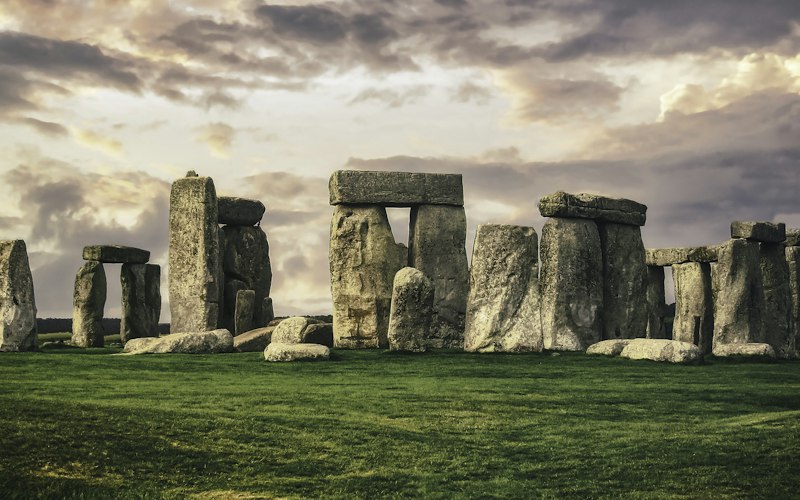
Stonehenge
Amesbury, Salisbury SP4 7DE, United Kingdom
Open in Google Maps →Stonehenge is perhaps the most famous prehistoric monument on Earth, a circle of massive standing stones erected on Salisbury Plain around 5,000 years ago by Neolithic and Bronze Age peoples whose motivations remain one of archaeology’s greatest mysteries. The iconic ring of sarsen stones, each weighing up to 25 tons and standing over 4 meters tall, topped by horizontal lintels that create a continuous circle, is an engineering achievement that still baffles researchers. Even more remarkable is that the smaller bluestones at the center were transported from the Preseli Hills in Wales, over 240 kilometers away, a logistical feat that implies these specific stones held profound significance for the builders.
The monument’s alignment with the sunrise on the summer solstice and the sunset on the winter solstice strongly suggests an astronomical purpose, though theories about its exact function range from temple to healing center to astronomical observatory. The excellent visitor center, located two kilometers from the stones, houses a museum with remarkable Neolithic artifacts including tools, pottery, and the reconstructed face of a man who lived near Stonehenge 5,500 years ago. Outside, a cluster of reconstructed Neolithic houses shows how the builders might have lived. A shuttle or a pleasant walking trail connects the visitor center to the stones themselves, which rise from the open grassland with a stark, elemental power that photographs cannot fully capture.
Pro tip: Book a Special Access visit through English Heritage for either the early morning or late evening slot, which allows you inside the stone circle before or after regular hours when the general public must view from a roped path 15 meters away. These intimate sessions are limited to 30 people and offer an unforgettable, almost spiritual connection with the stones. They sell out months in advance, so plan well ahead.